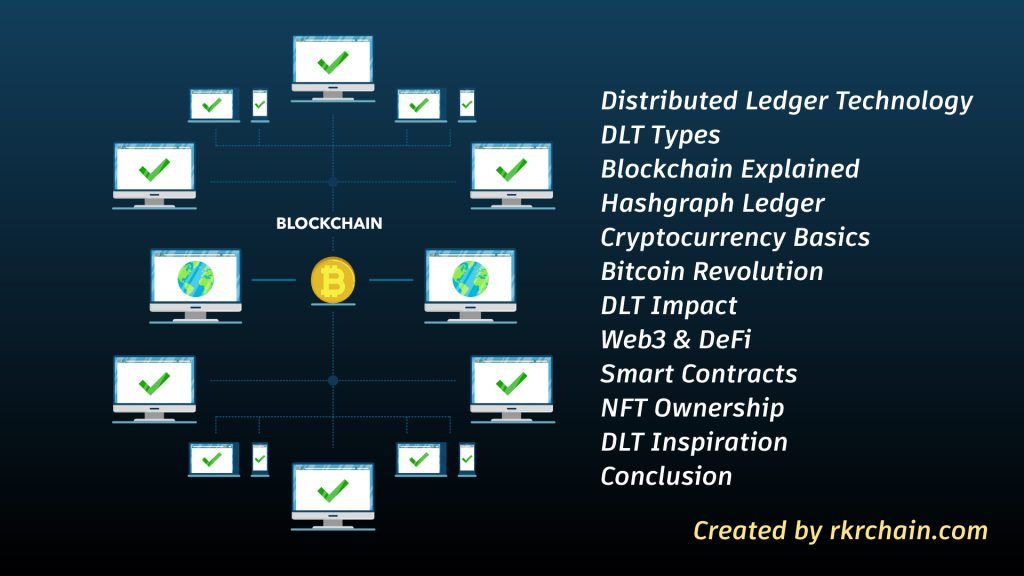
What is Distributed Ledger Technology (DLT)? History and Why It’s Important
Imagine you and your friends are keeping track of who owes candy to whom. Instead of one person writing it down in a notebook, everyone has the same notebook. Every time someone gives or gets candy, everyone updates their notebook. This is Distributed Ledger Technology (DLT)—a ledger shared across multiple computers where everyone agrees on updates.
History:
- 1990s: Early ideas of digital cash
- 2008: Satoshi Nakamoto launches Bitcoin using blockchain
- DLT allows trust without central authority, making transactions secure and transparent
Example: Think of DLT like Google Docs instead of a Word file. Everyone sees changes in real-time, and nothing can be secretly erased.
Check Investopedia’s article on DLT
Different Types of DLTs: Blockchain, Hashgraph, and Beyond
Not all ledgers are the same. Here are a few main types:
Blockchain (2008) – Uses blocks linked together like LEGO bricks.
Hashgraph (2016) – Uses “gossip” to spread information and virtual voting to confirm transactions. Fast and efficient.
Other DLTs – Next-gen systems combine scalability, speed, and low energy use.
Key Point: All DLTs solve trust, transparency, and record-keeping in different ways.
Or download the pdf on Hashgraph
What is Blockchain? How It Changed the Digital World
Blockchain is a type of DLT where transactions are recorded in blocks, and each block is linked to the previous one using cryptography.
Example: Imagine a chain of sealed envelopes where each envelope contains a list of transactions. Once sealed, it cannot be changed. This chain grows longer over time, and everyone keeps a copy.
Impact:
- Introduced Bitcoin in 2009
- Enabled smart contracts in Ethereum (2015)
- Changed industries like finance, supply chain, and healthcare by offering trustless systems
What is Hashgraph? The Next-Gen Ledger
Hashgraph is another type of DLT but faster and more energy-efficient than traditional blockchain.
How it works:
- Uses a “gossip about gossip” method to share information
- Uses virtual voting to agree on the order of transactions
- Can process thousands of transactions per second
Easy Example: Imagine everyone in a classroom whispers a secret to neighbors, and soon everyone knows the secret. Then the class votes on what really happened—fast and fair!
Cryptocurrency and Its Connection to DLTs
Cryptocurrency is digital money built on DLT. The most famous is Bitcoin, but thousands of others exist.
Why DLT matters:
- Ensures transactions are secure, transparent, and decentralized
- No single bank or government controls it
- Enables peer-to-peer payments worldwide
Example: Sending 1 Bitcoin from Bangladesh to France is like handing digital cash directly to a friend without using PayPal or a bank.
Bitcoin Explained: The Store of Value Revolution
Bitcoin, launched in 2009, is the first cryptocurrency.
Key Points:
- Limited supply: only 21 million Bitcoins exist
- Known as “digital gold” because it can store value over time
- Uses blockchain to ensure no one can cheat and double-spend
Example: Think of Bitcoin like rare Pokémon cards. You can trade them, and everyone knows exactly how many exist.
The Core Impact of DLT on the Modern World
DLT has changed the world in several ways:
- Finance: Faster, cheaper cross-border payments
- Supply Chains: Track goods from factory to store
- Digital Identity: Secure online identity without a central authority
- Governance: Transparent voting systems
Example: A diamond company can track every diamond from mine to market, preventing fraud.
Web 3.0, DeFi, and the Future of Unlocking Opportunities
Web 3.0 is the next internet built on blockchain:
- DeFi (Decentralized Finance): Banking without banks
- DAOs (Decentralized Autonomous Organizations): Groups run by code instead of managers
- Ownership: Users control data, content, and money
Example: Imagine earning interest on your money directly from other people online, without a bank taking fees.
Smart Contracts: Unlocking Programmable Money and Automation
Smart contracts are computer programs on blockchain that automatically execute actions when conditions are met.
Example: You rent a movie, and the payment automatically goes to the creator when you press play—no middleman required.
Impact: Reduces fraud, automates tasks, and creates new business models.
NFTs (Non-Fungible Tokens): Unlocking Digital Ownership
NFTs are unique digital items stored on a blockchain.
Example: Owning a digital art piece, music, or even a tweet. Each NFT has proof of ownership, like a digital certificate.
Years: NFTs became mainstream in 2021 with big art and celebrity projects.
Impact: Redefines ownership in the digital world, from art to collectibles.
Lessons, Passion, and Obsession: How DLT Can Inspire Entrepreneurs
DLT teaches us:
- Innovation is key—new ideas like Bitcoin and Ethereum started as experiments
- Trust is programmable—systems can replace traditional trust
- Persistence matters—entrepreneurs must learn, adapt, and experiment
Example: Many startups today use blockchain to solve problems in healthcare, logistics, and finance.
Conclusion: Keep Unlocking the Potential
DLT, blockchain, hashgraph, and cryptocurrencies are more than tech—they are tools to reimagine trust, ownership, and value.
From Bitcoin to NFTs, from Web 3.0 to smart contracts, understanding these technologies empowers you to unlock new opportunities in the digital world.
Final Thought: The future is decentralized. Start learning today, and you might create the next big breakthrough!